
You are certainly dealing with more data today than at any previous time in your organization’s history. Clinical systems, billing platforms, patient portals, telehealth tools, and partner networks all contain sensitive information. If these systems remain isolated, your teams will have difficulties. If you link them without proper controls, you are opening the door to risks.
Secure healthcare data integration that is secure provides you with an opportunity to connect the systems without exposing your organization. When you combine integration with healthcare compliance data integration standards, you facilitate the work of clinicians, ensure patient safety, and lessen the stress of audits. A necessary step is to view every integration choice as a compliance and security one, not just a technical one.
What Is Healthcare Data Integration
Healthcare data integration combines data from different systems so that it can be used in a unified manner. You connect EHRs, lab systems, pharmacy platforms, billing, CRM tools, and population health solutions. You format standardize, map fields, and move data in a controlled, consistent flow.
In safe healthcare data integration, you introduce strong security measures for each part of this process. You safeguard data when it is being transferred and when it is stored. You control access, logging, retention, and change management. You also make sure that every interface and every pipeline is in line with the compliant healthcare data integration requirements.
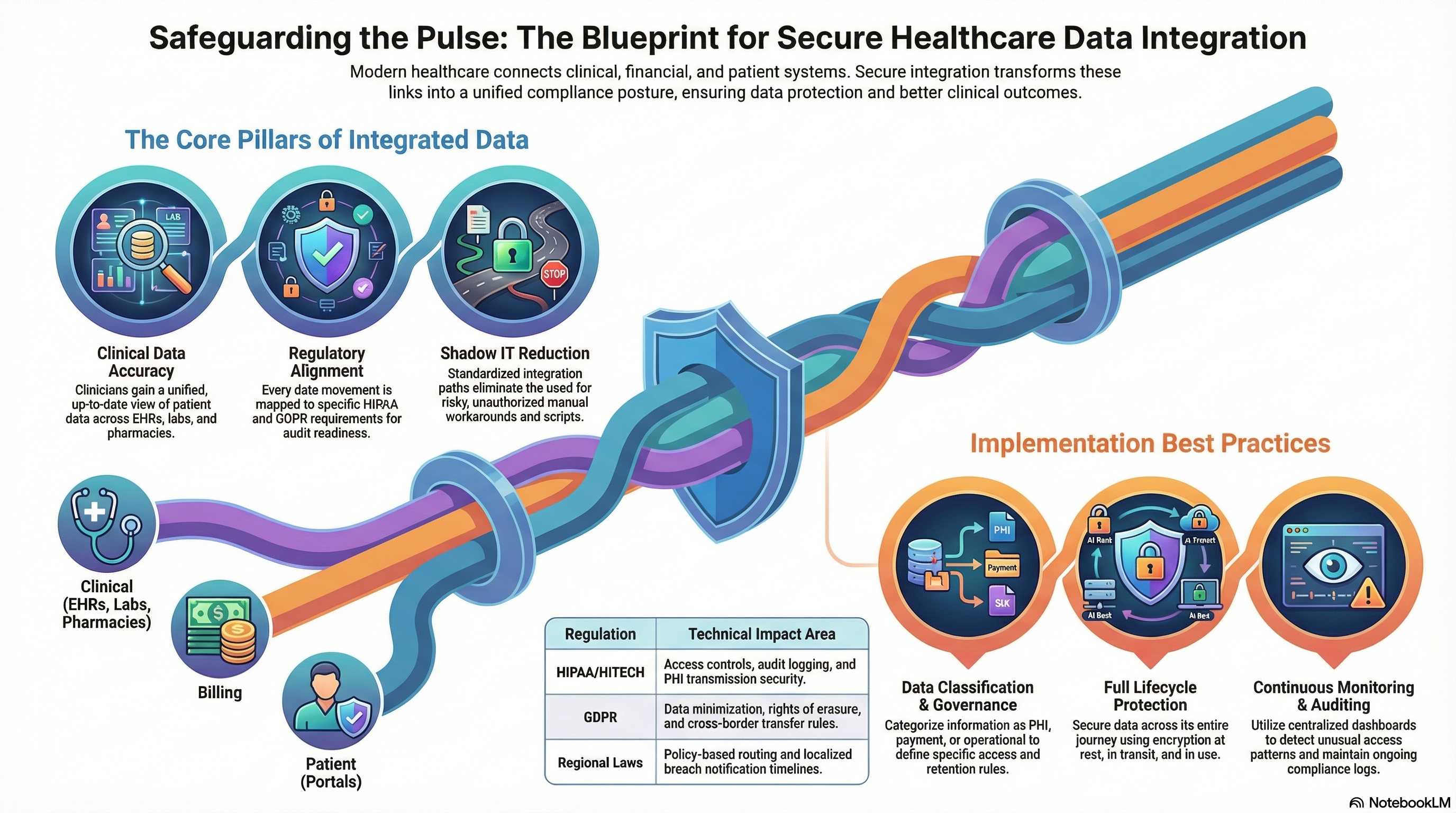
Basically, healthcare regulatory data integration is centered on three results:
- Clinical users get to see accurate and up, to, date data from different systems.
- Security teams keep a grip on and have a good picture of the data usage with control.
- Compliance teams are able to demonstrate how each data movement is in accordance with the policy.
If you make integrations from this point of view, you avoid repeating work. You also diminish the risk of duplicate records, manual workarounds, and shadow IT interfaces that add risk.
Why Compliance and Security Are Critical in Healthcare
In healthcare, data has a direct impact on patient safety, trust, and legal exposure. When left unprotected, it becomes a lure for criminals. When abused, it causes loss of trust. When handled incorrectly, it results in fines and damages the reputation.
Secure healthcare data integration enables you to consider every connection as part of your compliance posture. You are in line with the law and ethical requirements not only by making a technical decision but also by a legal one. You can reassure the compliance team that integrations will not be disruptive to the audit or investigation process.
The benefits of healthcare compliance data integration are:
- You significantly lower the risk that someone unauthorized will have access to sensitive health information.
- You maintain a reliable log of accesses including the individual who accessed and the time, date and location.
- You ensure that consent management remains consistent across all the integrated systems.
- You minimize the possibility of patient data being sent to the wrong recipient or being incomplete during the clinical workflow.
In addition, strong security and compliance also lead to operational advantages. The teams get to spend less time on manual reconciliations and on fixes of unexpected situations. Your environment is trusted by vendors and partners. Internal stakeholders see integration as a facilitator rather than a threat.
Key Regulations Impacting Data Integration (HIPAA, GDPR, etc.)
Healthcare regulatory data integration is not a standalone activity. It is embedded in a complex network of regulations and industry standards. An integration strategy of yours should translate the requirements in practical, technical terms.
Many regulations are affecting your choice of the HIPAA-compliant data integration design and other controls.
HIPAA and HITECH
HIPAA establishes standards for the confidentiality and security of protected health information.
For integration, this impacts:
- Access control across systems and interfaces.
- Audit logging and the ability to reconstruct events.
- Integrity controls to protect against improper alteration.
- Transmission security for data in motion.
- Business associate agreements with vendors that process PHI.
HIPAA-compliant data integration is consistent with these requirements in each interface. It does not depend on a single perimeter. It places controls at every point where PHI is moved or transformed.
GDPR and Global Privacy Regulations
For European Union residents’ data, any kind of processing by companies must be done in accordance with GDPR which imposes stringent regulations regarding:
- The legal basis for processing and data minimization.
- The limitation of purpose and transparency in data usage.
- Rights of data subjects, including the right to access, rectify, and erase.
- Controls over the transfer of data, particularly cross-border.
When it comes to integrating healthcare data that is secure, these guidelines dictate the manner in which you duplicate, keep, and disclose personal data. Moreover, they have a bearing on how you create consent flows and how you facilitate requests for rights of subjects across different systems.
State and Regional Healthcare Requirements
Numerous areas of the world have their own sector specific privacy and security laws. These by and large intersect with HIPAA but are capable of adding distinct requirements. For instance, a few states specify extra patient rights or set different timelines for breach notifications. Your healthcare regulatory data integration strategy should be able to incorporate these differences.
On the ground, it entails:
- Identifying data according to location and regulatory scope.
- Enforcing policy, based routing and access control rules.
- Keeping records of consent and limitations in such a way that they can be communicated across different systems.
How Secure Data Integration Supports Compliance
Technical teams frequently perceive compliance objectives as vague. Secure healthcare data integration makes those objectives tangible. You interpret privacy and security requirements into integration patterns and guardrails.
When you create a compliant healthcare data integration plan, you are essentially helping:
- Confidentiality, by encrypting data, controlling access, and segmenting.
- Integrity, by validating, normalizing, and using consistent identifiers.
- Availability, by making integrations resilient and pipelines monitored.
These are not something different from clinical or business outcomes. They are the means to have the right to share information among care teams, payers, and partners.
Aligning Technical Controls With Policy
Compliance teams develop policies on the use and protection of PHI. Secure healthcare data integration reflects those policies at the integration layer. If necessary:
- Role based access corresponds with fine grained API permissions.
- Retention policies correspond to automated archival and deletion jobs.
- Use restrictions correspond to field level filtering during data exchange.
This synchronization between the two halves lessens policy drift. It also simplifies audits, as you can show the auditors how each requirement is paired with a technical control.
Reducing Shadow Integrations
Whenever the official formal integration avenues have been too slow or too stringent, teams have been inclined to create their own data interchanges. This might take the shape of manual exports, unauthorized APIs, or local scripts. They all pose security and compliance risks.
To a certain extent, a healthcare data integration platform that is also compliant facilitates and steers teams towards the correct way. You provide reusable connectors, standardized patterns, and clear rules. Hence, the teams become less dependent on the uncontrolled workarounds.
Supporting Incident Response and Investigations
You need to have a clear understanding of what happened when a problem occurs. HIPAA-compliant data integration entails effective logging and monitoring. You keep records of:
- In and out calls.
- Data modifications.
- Authorized attempts and failures.
- Changes in settings.
Such information gives your security and compliance team strong proof. They can react faster, reduce the damage, and record the measures taken to correct the mistake.
Best Practices for Healthcare Data Security and Compliance
Healthcare data security best practices will yield the greatest results if you implement them in all the integrations in your network, not just in your EHR core.
These practices take the load off the regulatory compliance and accommodation of internal policies when the healthcare organization is setting up data integration.
1. Start With Data Classification and Governance
Before integrating systems, you should be aware of what kind of data you are dealing with. Categorize different types of data such as PHI, payment information, operational, and analytical. Determine the ownership and stewardship of each data set. Next, establish rules for access, retention and sharing. Your integration layer should be able to comprehend these rules and implement them. This is a smart solution that tightly connects healthcare regulatory data integration to governance and not just to point, to, point connections.
2. Use Standardized, Secure Integration Patterns
Dont go for one-off solutions. Design a small set of standard integration patterns that you know are secure and compliant.
For instance:
- API based exchange with strong authentication and authorization.
- Event, driven integrations with secure message queues and routing rules.
- Batch jobs with encrypted file transfer and controlled processing windows.
Write down for each pattern how it supports HIPAA-compliant data integration as well as other regulatory expectations. Use these patterns for new connections to lower the risks and the engineering effort.
3. Protect Data Across Its Entire Lifecycle
Best practices for healthcare data security cover the entire data lifecycle. In the context of integration, it is:
- Use of strong encryption and secure protocols to cover data in transit.
- Data at rest should be protected by encryption, key management and access control.
- Data in use is managed through role, time-based access, context-aware rules, and monitoring.
- Data disposal is to be in line with the retention and destruction policies.
Your integration platform should naturally have these controls in place to support them, and not be adding them as a patch.
4. Implement Strong Authentication and Authorization
Access control is crucial for secure healthcare data integration. Make the identities consistent between different systems so that uniform access policies can be enforced. Use current authentication protocols and establish roles and authorization scopes in a standard way.
Associate the business roles, e.g., clinician, billing specialist, or external partner, with certain permissions in your integration layer. Never give out default access. Perform access reviews regularly to make sure that the permissions are aligned with the roles.
5. Monitor, Audit, and Continuously Improve
Monitoring and auditing ensure that your healthcare integrations remain compliant with the healthcare data integration standards not only at the time of implementation but also over time.
Develop a consolidated dashboard that provides a clear picture of the overall integration performance. Include in your monitoring both the operational metrics and the security pertinent events.
You may leverage this information to:
- Detect unusual access or data movement patterns.
- Find out the interfaces that are failing or working at a very low level before they have an impact on the quality of care.
- Help continuous improvement and remediation plans.
Consider healthcare data security best practices as a discipline that needs to be exercised continually rather than a project that is done once.
Challenges in Maintaining Secure Healthcare Data Integration
Keeping healthcare data integration both efficient and secure is a challenge even if you have a robust plan. A lot of organizations are having problems updating their old IT systems, dealing with a variety of vendors and a changing set of rules.
Legacy Systems and Proprietary Interfaces
Some very old healthcare systems are stuck with proprietary formats and hardly any security controls. It takes a lot of efforts to integrate these systems without allowing the data to fly out. You will probably require translation layers, additional access controls, or compensating controls around logging and monitoring.
An integration platform specialized in healthcare standards and vulnerabilities that focuses legacy patterns can help you reduce the complexity. It also lowers the risk that your teams, desperate for shortcuts, end up compromising the compliant healthcare data integration.
Vendor Sprawl and Third Party Risk
Generally, healthcare organizations have multiple vendors and partners. Every external connection brings a shared responsibility for security and compliance. You have to deal with business associate agreements, data processing agreements, and technical integration controls.
If you don’t have a centralized approach, you get inconsistent standards across vendors. While some connections are up to healthcare data security best practices, others are lagging. A central integration strategy enables you to apply consistent controls and monitoring to every external link.
Regulatory Change and Organizational Growth
Regulations, enforcement priorities, and organizational structures evolve over time. Your integration design should be sufficiently flexible to accommodate these changes without going through an entire redesign. If your interfaces are hard-coded and brittle, every change will be a source of trouble and will take time.
Healthcare regulatory data integration can be made more manageable through abstraction. You can set up policies and routing in the same place and then reuse them across all endpoints. In case of a rules change, you will just update the policy layer rather than rewriting every single point to the point connection.
Internal Alignment Across Teams
Secure healthcare data integration involves several teams such as technical, clinical, security, privacy, and compliance. If there is no shared ownership, decision-making is likely to become fragmented. One team will be concerned with speed, another with safety, and yet another with user experience.
The solution is clear governance. Decide on roles and who has the right to make decisions. Have a playbook that demonstrates that healthcare compliance data integration dictates the design decisions. Engage the most relevant stakeholders early on and not only during the review phase.
Conclusion
Healthcare providers cannot simply overlook integration. Doctors have to be able to get hold of patient data in a timely manner. A hospital’s revenue cycle is reliant on having accurate data at all times. The partners in a network expect to be digitally connected. Besides that, regulators, patients, and the management team expect that very sensitive data is adequately protected.
Secure healthcare data integration is the way you can satisfy both groups of requirements. In essence, it means that you link up the systems, but still keep control. It means that you synchronize technical architecture with healthcare data compliance requirements for integration. It means that you lower your exposure to risk while still enabling a higher level of care and more efficient practice.
Vorro offers an integration platform and services that are healthcare-focused and support HIPAA-compliant data integration, unified governance, and strong security controls over complex environments. You can arrange a meeting with Vorro if you wish to review your existing integration strategy and consider the integration modernization that remains secure, compliant, and safe.
FAQs
What is secure healthcare data integration?
Secure healthcare data integration is essentially a process of connecting clinical, financial, and operational systems while ensuring that the sensitive data is protected at every phase.
This includes measures such as encryption, access control, logging, and governance that comply with the regulations. The goal is to move care data securely among care teams, payers, and partners without exposing PHI to unnecessary risks.
How does HIPAA affect data integration projects?
HIPAA specifies the privacy and security standards for Protected Health Information or PHI. For an integration project, this determines the methods of user authentication, access authorization, data encryption during transfer and storage, and activity logging. A HIPAA-compliant data integration means that each interface and data pipeline abides by these rules and that service providers handling PHI sign the right agreements.
What are healthcare data security best practices for APIs?
The best healthcare data security practices for APIs involve, from a healthcare perspective, the layering of security measures such as strong authentication, very granular authorization, encrypting the entire traffic, rate limiting, detailed logsMaintaining uniformity in API patterns, scrutinizing both input and output, and aligning API scopes with clinical or business roles are necessary steps. These steps enable the secure exchange of healthcare data between internal and external applications.
Why is centralized governance important for compliant healthcare data integration?
Centralized governance acts as a sole reference for data policies, access rules, and integration standards. If this is missing, different teams end up making their own connections which are not only inconsistent but also might be against regulations. On the other hand, once governance is established, healthcare regulatory data integration can become not only more predictable and auditable but also easier to manage when systems and requirements change.
How can Vorro help with healthcare compliance data integration?
Vorro is targeting mainly secure healthcare data integration among providers, payers, and partners. The platform mediates complicated interfaces, enforces uniform security controls, and caters to HIPAA compliant data integration patterns. Vorro collaborates with your teams to integrate design with healthcare compliance data integration requirements so you can have better data flow at no additional risk.
