
There is an abundance of clinical and operational data you are sitting on, your systems, however, keep it locked in silos. You are being pressured by clinicians, operations, and finance to connect everything, improve quality, and reduce friction while keeping patients safe and satisfying regulators.
A good healthcare data integration platform enables you to achieve that with control and predictability. Using a wrong one only adds complexity, delays, and hidden risk.
This guide provides you with the steps to take when selecting a healthcare integration platform. You will discover what really matters, what to ignore, and how to compare vendors so you can get the best healthcare data integration solutions for your organization.
What Is a Healthcare Data Integration Platform
A healthcare data integration platform is an intermediary that links your clinical, financial, and operational systems so that data is exchanged between them in a reliable and controlled manner. It is positioned between your source and target systems and coordinates how messages, documents, and APIs communicate.
Basically, a healthcare data integration platform assists you with:
- Linking EHR and EMR systems with downstream applications
- Accommodating HL7, FHIR, X12, and other healthcare standards
- Converting and harmonizing data formats
- Creating, overseeing, and handling interfaces at a large scale
- Enhancing data quality and reliability for analytics and reporting
When you deliberate about purchasing healthcare data integration tools, you are essentially setting how your organization will deal with interoperability over the next few years. You are not getting a piece of software. You are determining an integration strategy for your clinical workflows, partner connections, and patient experience.
The proper healthcare IT data integration platforms provide you with:
- A single point of control for data movement and transformation
- Standardized integration patterns across departments
- A shared basis for digital health, population health, and value based care initiatives
This is the main reason why the decision merits a systematic approach, rather than a mere list of technical requirements.
Key Features to Look for in a Healthcare Data Integration Platform
Start by linking features to the actual work done by your teams. Consider how quickly you can roll out new integrations, how effortlessly you can accommodate changes, and how well you can confidently maintain them over time.
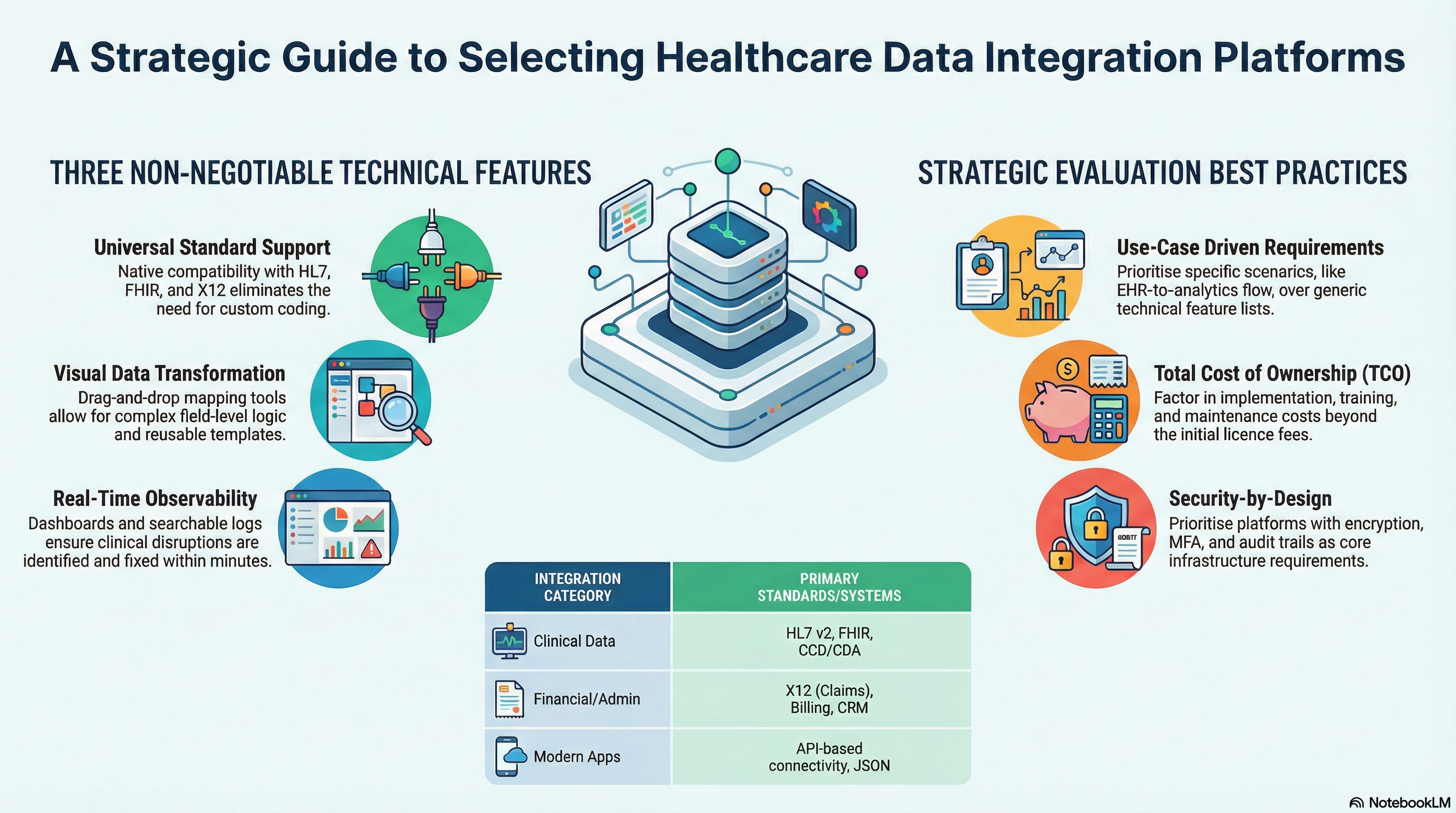
1. Strong support for healthcare standards
Your healthcare data integration platform must have built, in compatibility with major healthcare standards such as HL7, FHIR, and X12. Ideally, it should be able to work with standard message types, acknowledgment patterns, and error handling without requiring major custom coding.
See if the platform offers:
- Out of, the, box components for HL7 v2 messages
- FHIR resource handling and mapping facilities
- Comprehensive X12 processing for claims and eligibility
- Support for CCD, CDA, and other clinical document formats, where applicable
When you prioritize selecting healthcare data integration tools, this feature usually distinguishes healthcare-specific platforms from generic middleware.
2. Flexible data transformation and mapping
Transformation is almost always part of an integration project. Different codes, different formats, and each partner having their own guidelines. Your platform should allow you to set data mappings visually or through a clear configuration rather than exclusively in custom code.
Consider:
- Drag and drop mapping tools capable of complex field, level logic
- Ability to reuse mapping templates for different interfaces
- Incorporation of validation, enrichment, and normalization steps
The greater the reusability you
3. End to end monitoring and observability
Picking a healthcare integration platform cannot be done without considering monitoring in detail. When clinicians are disrupted due to a fault, it usually takes them less than a minute to realize. It is essential that you know what went wrong, where and be able to fix it quickly.
Key elements:
- Real time dashboards for interface healthS
- earchable message logs with full traceability
- Clear error messages and alerting workflows
- Support for role based access to operational views
This feature of your platform essentially decides the number of times your team is roused at odd hours to deal with emergencies and the speed at which the flow is restored to normal.
4. Low friction interface development
Your team will be responsible for the development and maintenance of integrations over the years. The more difficult the development experience is, the greater the complexity becomes. Your healthcare data integration platform should give your team a way that is easy and smooth to work from a request to a production.
Features:
- Reusable building blocks and templates
- Configuration-driven flows rather than extensive custom code
- Version control and rollback support
- Clear test environments that mirror production
This is the stage at which healthcare data integration tools choices with the correct degree of abstraction directly lead to delivery speed and quality.
5. Governance and access control
Data integration involves the use of clinical and sensitive information, thus, governance is a key issue. You have to be able to identify who changed what, when they changed it, and why.
Consider:
- Fine grained role based access control for configuration and monitoring
- Audit trails for configuration changes and deployments
- Wherever necessary, support for approval workflows
Good governance features protect you from accidental changes, inconsistent practices, and audit exposure.
Evaluating Security, Compliance, and Scalability
Security and compliance represent a non, negotiable backbone in healthcare IT data integration platforms. A platform of your choice should inherently regard security and privacy as the utmost design requirements, rather than add, on features.
Security controls and data protection
Your platform must allow features such as encryption both during the data transfer and when data is at rest, should have very secure authentication, and work well with your identity and access management systems. Study how the platform conducts data separation of tenants, certificate management, and the security of administrative interfaces.
- Encryption standards for data at rest and in transit
- Support for single sign on and multi factor authentication
- Network isolation options and API gateway integration
- Patch and vulnerability management processes
Security features should not be a separate thing but rather complement seamlessly with your existing controls and risk posture.
Regulatory compliance alignment
Healthcare integration entails handling protected health information. Therefore, your healthcare data integration platform must be capable of fulfilling compliance requirements concerning privacy rules, security rules, and audit requirements.
- Audit logging for access, changes, and data flows
- Support for data retention and deletion policies
- Controls for minimum necessary access and segregation of duties
Compliance should not be a mere tick in the box. Evaluate how the platform can help you in bringing these controls to life in actual workflows.
Performance and scalability
As additional systems and partners are connected, the volume increases.
It is necessary to have a healthcare data integration platform which can maintain low latency, and stable throughput without the need for constant re-architecture, even if volume becomes high.
How the platform:
- scales using multiple instances or nodes
- balances load across interfaces and connections
- manages surge traffic during peak hours or batch runs
- allows capacity planning and performance monitoring
Scalability is more than just a technical issue. It also impacts the capability of going for new integration projects without hindering the pace of the existing ones.
Integration Capabilities: EHR, EMR, HL7, FHIR, and More
Your integration platform’s success depends largely on what it connects with and how easily it can connect. Both EHR and FHIR integration platforms must be capable of supporting traditional interfaces and modern APIs simultaneously.
EHR and EMR connectivity
Begin with your main EHR or EMR. Your healthcare data integration platform must:
- Facilitate the vendor’s preferred integration patterns and protocols,
- Manage core clinical workflows like orders, results, scheduling, and registration,
- If you have one, work well with your EHR messaging or integration engine.
This is the point where extensive healthcare knowledge makes a difference. The more your vendor can offer prebuilt patterns and share experiences, the less your team has to redo work.
HL7 support
HL7 v2 remains the backbone of the majority of organizations. Your platform should help make HL7 interfaces more stable and predictable. Consider:
- Predefined HL7 message profiles and templates,
- Support for common acknowledgment workflows,
- Tools for parsing, validating, and routing HL7 messages.
Reliable HL7 support basically turns the periodic upgrading task into a well, managed process.
FHIR and API based integration
Today’s applications are designed for API based connectivity. EHR and FHIR integration platforms can help you serve internal and external consumers in an organized way.
Think if the platform:
- Supports FHIR resources and versions that are in line with your EHR roadmap
- Has the capability to easily translate HL7 messages into FHIR resources and vice versa
- Handles authentication, authorization and rate limiting for API use smoothly
This is critical especially since there are more digital health partners, remote monitoring tools, and patient facing apps that are reliant on FHIR based data exchange.
Beyond clinical systems
You shouldnt stop at integrating clinical applications when youre looking at your healthcare IT data integration platforms. The real value is when you:
- Integrate healthcare IT data with revenue cycle, billing, and financial systems
- Connect CRM and patient engagement tools
- Link analytics platforms and data warehouses
- Integrate claims and payer connectivity
The more you keep consistent your integration model across clinical, financial, and operational tools, the more complete and trustworthy your data will be.
Cost, Support, and Vendor Considerations
Technical features matter, but the overall value of a platform depends largely on whether it is a good fit for your team, budget, and long, term strategy. Hence, consider this as making a strategic partnership decision.
Understanding total cost of ownership
When comparing options for the healthcare integration platform, dont just look at license fees. Take into account the following:
- Infrastructure or hosting costs if any.
- Implementation and migration costs
- Training and enablement for your team
- Ongoing support and maintenance
- Costs related to adding new interfaces or connections
On top of that, think about the opportunity cost of slow delivery. If your team spends more time struggling with tooling than delivering integrations, your real costs increase rapidly.
Vendor expertise and healthcare focus
The top healthcare data integration solutions result from vendors who immerse themselves in healthcare daily. You need a partner who gets clinical workflows, payer relationships, and regulatory pressures.
Assess:
- Amount of healthcare experience
- Check references clients at the same scale and also complexity
- Familiarity with your major EHR, EMR, and payer systems
One who has a complete practical health knowledge, not someone who only knows theory. Such a vendor should bring actual patterns, reusable accelerators, and proven approaches.
Support model and partnership
Support is often one place where you experience the true value of a vendor. Whenever an integration fails, your team demands a quick and well, informed help.
Look for:
- Well, defined support level and expected times of response
- Getting hold of skilled healthcare integration specialists
- Proactive system monitoring and advisory interventions
- Educational and knowledge dissemination programs
A good vendor partnership changes your healthcare data integration platform from being a product you manage on your own, to a joint venture.
Best Practices for Selecting the Right Platform
Making a well, informed decision about a healthcare integration platform is best done through a systematic approach. Ideally, you want to tie business objectives, technical specifications, and a vendor comparison together logically.
1. Start with use cases, not feature lists
Identification of your top integration scenarios should be the starting point. For instance:
- exchange of patient information between inpatient and ambulatory systems
- linking the EHR data to analytics and reporting tools
- Collaborating with payers for eligibility, authorizations, and claimsenable a digital front door or remote monitoring program
- Deriving your requirements based on these scenarios.
This makes it more about the results rather than just a list of generic features.
2. Involve both IT and clinical stakeholders
On the one hand, tech teams are the ones who understand the integration intricacies. On the other hand, clinical and operational executives comprehend the changes at the workflow level. Both perspectives are necessary.
The following are some examples of stakeholders that you can include:
- Clinical operations and nursing
- Physician leadership
- Revenue cycle and finance
- Compliance and securityAnalytics and data management
Such a unified understanding minimizes duplication of effort and fosters backing of the platform choice.
3. Run realistic proof of value projects
Instead of highly theoretical demos, suggest the vendors demonstrate their capability through a focused, high, impact use case. For instance, one potential use case could be a specific HL7 interface, or a targeted FHIR based integration, or a connection to a key partner.
Leverage this to measure:
- Time from kickoff to delivery of a working interface
- Ease of configuration and mapping
- Quality of documentation and support
- Clarity of monitoring and troubleshooting
What you are doing here is exposing both the product and the partnership to the real conditions.
4. Plan for skills, not only technology
Even the most advanced healthcare data integration platform requires the right skills in your team to leverage its full potential. Imagine how your integration team will operate in the new environment.
Think about:
- Training plans for analysts and engineers
- Governance for interface design and approval
- Shared standards for mapping and documentation
- Onboarding plans for new team members
Highly developed skills and practices are what really transform technology capabilities into reliable results.
5. Assess future fit, not only present fit
The data integration requirements that you have for today come from the programs that you currently have. Your demands a few years down the line will likely involve new care models, partner ecosystems, and analytics expectations.
Ask how the platform supports:
- API first strategies and FHIR evolution
- Cloud, hybrid, or on premises flexibility
- Growth in external partner connections
- Higher demands from analytics and AI driven use cases
Picking healthcare data integration tools that have a clear roadmap and vision will help minimize the risk of another major platform change in the future.
Conclusion
A healthcare data integration platform is at the heart of your digital health strategy. It impacts clinician experience, patient experience, compliance posture, and your ability to adapt to new requirements.
By prioritizing healthcare integration platform selection based on real use cases, security, standards support, monitoring, and long term partnership, you are setting your organization up for success. You are no longer just reacting to the demands of the moment by creating one off interfaces but instead, you have a structured, scalable integration strategy.
Vorro is a great help to health systems, provider groups, and health IT organizations that want to modernize integration with a focus on results, not hype. Our team is packed with people who have deep healthcare experience, strong knowledge of EHR and FHIR integration platforms, and a practical approach to delivering and governing interfaces across your enterprise.
If you are looking for a partner that considers integration as a shared mission, check out how Vorro tackles healthcare data integration at vorro.net.
FAQs
What is the primary function of a healthcare data integration platform?
A healthcare data integration platform is a healthcare data integration platform that links your different clinical, financial, and operational systems so that data constantly flows between them. It handles interfaces, transformations, and routing and at the same time, it provides your team with monitoring, troubleshooting, and governance tools.
How do I start choosing healthcare data integration tools?
First, identify the use cases that give you the most value, like specific EHR integrations or payer connections. These use cases can then be used to develop the requirements. Vendors should be chosen based on how quickly, safely, and maintainably they can support those cases, rather than on generic feature lists.
Why are EHR and FHIR integration platforms important?
EHR and FHIR integration platforms are a great help in bridging traditional HL7 workflows with the demands of modern API based solutions. They facilitate the implementation of existing EHR interfaces and at the same time, they provide a clear guideline that allows digital health apps, partner solutions, and patient, facing tools that require FHIR, based access to be served.
What should I look for in healthcare IT data integration platforms about security?
First and foremost, check if the platform offers robust encryption, user identity integration, detailed audit logging, and whether it aligns with your security and compliance policies. A good platform will also allow you to control access, track data movements, and facilitate your privacy and data retention policies over all the connected systems.
How do I compare the best healthcare data integration solutions?
Assess the platforms against each other through the lens of total cost of ownership, the degree of healthcare experience, the quality of customer support, and their performance in realistic PoV projects. Places you deliver new integrations, ease with which you can handle change, and operating the environment over time with confidence should be the main highlight in your assessment.
